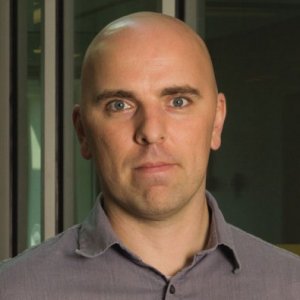
Tomasz Arodz is an associate professor in the Department of Computer Science at VCU. His research has been funded by NSF, NIH, and CDC. Dr. Arodz holds a Ph.D. in computer science from AGH University of Science and Technology in Krakow, Poland. He is a laureate of the Prime Minister of Poland Award for his Ph.D. dissertation. Dr. Arodz also holds a M.Sc. in biotechnology from Jagiellonian University in Krakow.
Accomplishments
Researcher of the Year 2020
2019-12-31 VCU Computer Science Department
NSF CAREER Grant Award
2014-12-31 National Science Foundation
Prime Minister of Poland Award
2007-12-31 Laureate of the Award for Ph.D. Dissertation
Foundation for Polish Science Scholarship
2005-12-31 Laureate of the Young Researcher Scholarship
By now the journey to 2018 can feel more like a crawl than a mad dash.
There's pressure to entertain family, reconnect with old friends and take that special someone on a memorable date. But a Richmond startup says artificial intelligence can solve the indecision over where to go and what to do. While some experts caution against placing exaggerated faith in artificial intelligence, early adopters are hoping for a more perfect holiday experience.
. . . Just remember, if you're struggling to plan a not-so-silent night, don't give up on your gut, says Tom Arodz, another VCU professor who studies machine learning.
"AI may learn to never recommend a symphony to heavy-metal lovers," Arodz says. "But just like with human instinct, it is often difficult to say why any particular recommendation is made."
Conference on Research in Computational Molecular Biology RECOMB'2022
We proposed a new group testing approach tailored for scenarios where quantitative measurements are available (e.g. Ct values in PCR tests). It allows using much fewer tests than there are samples to be tested.
As part of a large microbiome study by VCU cMEDA team, we created a machine learning model to quantify effects of human microbiome composition on pregnancy outcomes.
International Conference on Machine Learning ICML'2020
We used techniques from topology (embedding of homeomorphisms into flows) to analyze whether two popular recent architectures for creating invertible deep nets, neural ordinary differential equations and invertible ResNets, have the capability to model arbitrary invertible function.
Conference on Neural Information Processing Systems NeurIPS'2021
We designed a technique for reducing the size of embedding matrices and self-attention weight matrices in deep Transformer-based language models using a much more compact yet expressive representation based on Kronecker/tensor products.